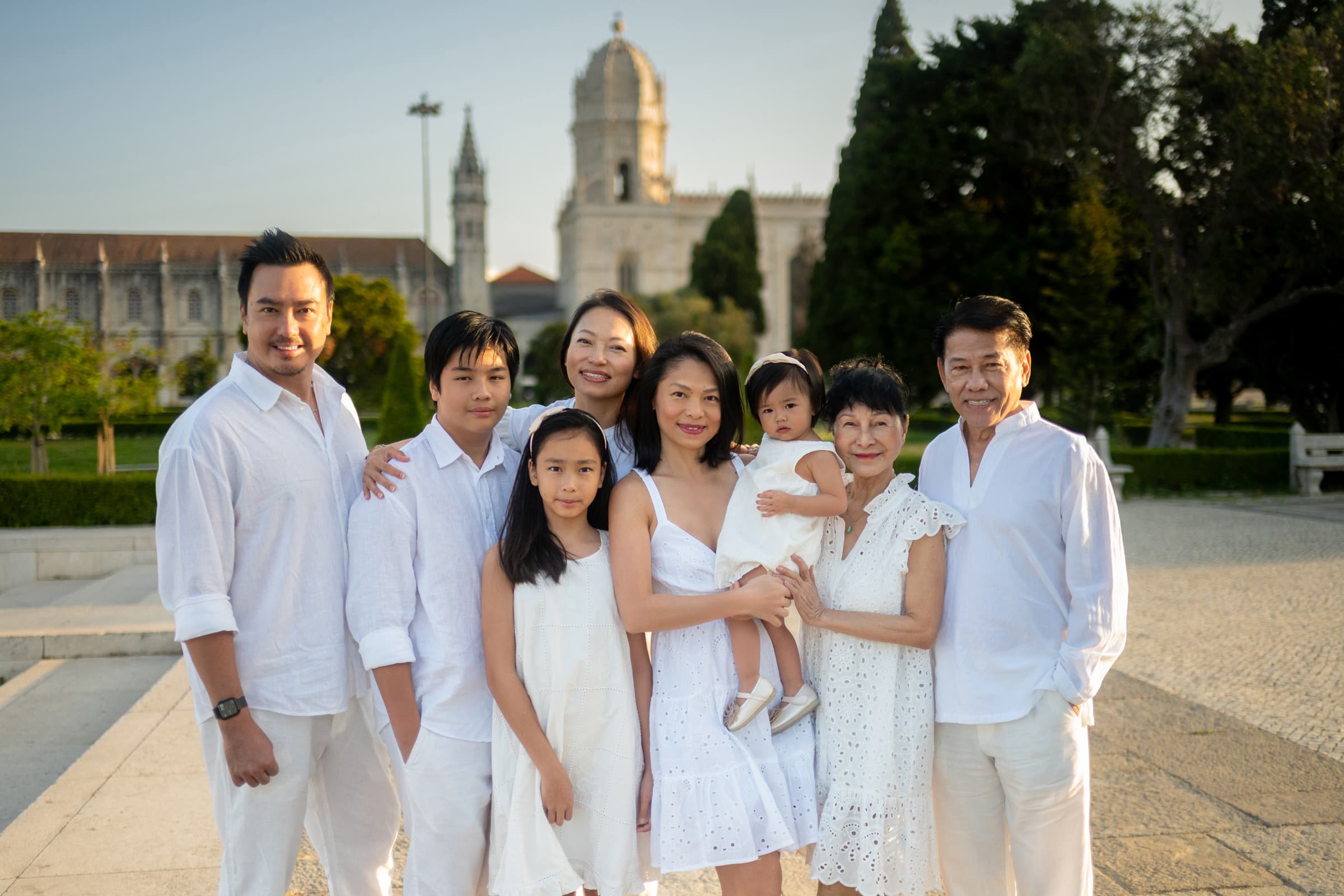
Family Photos in Lisbon: Where to Shoot, When to Go, and What Works with Kids
Date of publication: 02 Sep 2026 | Updated: 03 Sep 2026Most families write to me asking almost the same thing in different words: "We'll be in Lisbon for four days, where should we do the photos?" It sounds like a question about scenery. It almost never is. What they are really asking is where a two-year-old can be a two-year-old for forty minutes without a queue of tourists watching, and where the light will still be good when that forty minutes finally arrives.
So this is a guide to places, written from the practical end – Lisbon first, then the coast and Sintra, because half the families who write to me have a car for a day and want to know whether leaving the city is worth it. For each place I say what it gives you, what it costs you in return, and what time of day is actually best to shoot there. Where a session of mine exists, I link it, so you can see the place rather than take my word for it.
The short answer
If you only read one paragraph:
- Kids under three – a garden, or the lawns in front of the Jerónimos Monastery in Belém. Flat ground, shade, and room where nobody minds a tantrum. The monastery is not only a sunrise place: with a toddler the lawns matter more than the facade.
- School-age kids – Alfama or a viewpoint. They can walk, and the city does the work.
- Three generations together – Miradouro de São Pedro de Alcântara. There is somewhere to sit, and grandparents are not asked to climb anything.
- You want the ocean in the frame – Guincho, or Cascais if the children are small. Budget the drive, and dress warmer than you think.
- You have a car and one free day – the coast beats Sintra with small children: Sintra means traffic, parking and ticketed grounds, and it eats a morning.
- Only the middle of the day is free – Alfama or a garden. Both hold shade at any hour, which nowhere with a view does.
- You have seen Praia da Ursa in photographs – that view is from the top of the cliff, and it is where we would shoot. The path down is not a family route.
- You have one free morning and want the postcard – Jerónimos at sunrise. And in summer this is the general rule, not a trick for one place: at anywhere famous the morning is empty and the evening is a wall of people.
How I pick a spot for a family
Four things I look at first when I pick a place. And the order matters as much as the list. Believe me, these are not the things a travel blog with a list of locations would tell you: a travel blog is picking a view, and I am picking a place where small children will last an hour.
Shade, or the lack of it. From May to September the sun over Lisbon is hard and high until the very end of the day. A treeless square at two in the afternoon means squinting children and shadows under everyone's eyes. This single factor rules out more locations than everything else combined.
What is under their feet. Lisbon's calçada – the polished limestone cobbles – is beautiful, photographs wonderfully, and is genuinely slippery for a child who has been walking for six months. Safety and calm are worth more than a view while the child is still small. Which is why sand on a beach, or grass, is sometimes the better answer.
The time of day when it is busy, and when it is not. Every famous spot in this city has an hour when there is almost nobody, and an hour when it belongs to a coach party. The difference between those two hours is usually about ninety minutes, and knowing which ninety is most of my job.
The escape route. Where is the car, where is the nearest toilet, where is coffee. A session lives or dies on the twenty minutes after someone melts down, and a place with no way to reset is a place where the session simply ends.
1. Miradouro de São Pedro de Alcântara
The viewpoint above Bairro Alto, looking across the valley to the castle. My first suggestion when a family spans three generations, for an unglamorous reason: there are benches, low walls and a terraced garden, so the grandparents sit while the children run, and both end up in the same frame without anybody being marched anywhere.
I photographed a grandfather's birthday here – the whole family came up for it – and separately a sunrise session for two families at once, which is about the largest group this place takes comfortably.
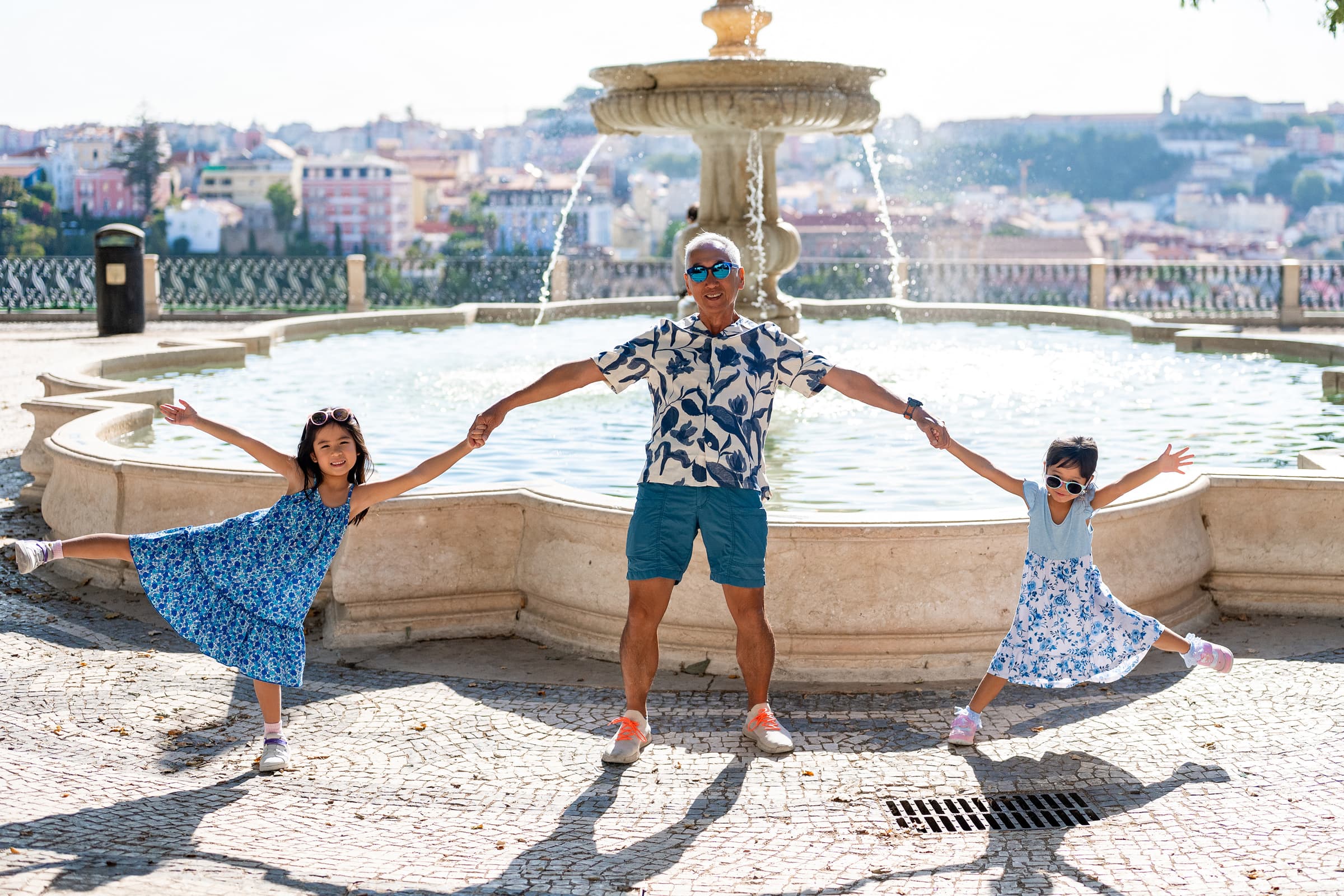
The trade-off: after about ten in the morning it fills up, and by sunset it is a wall of people watching the light with a beer. Early or not at all.
2. Belém and the Jerónimos Monastery
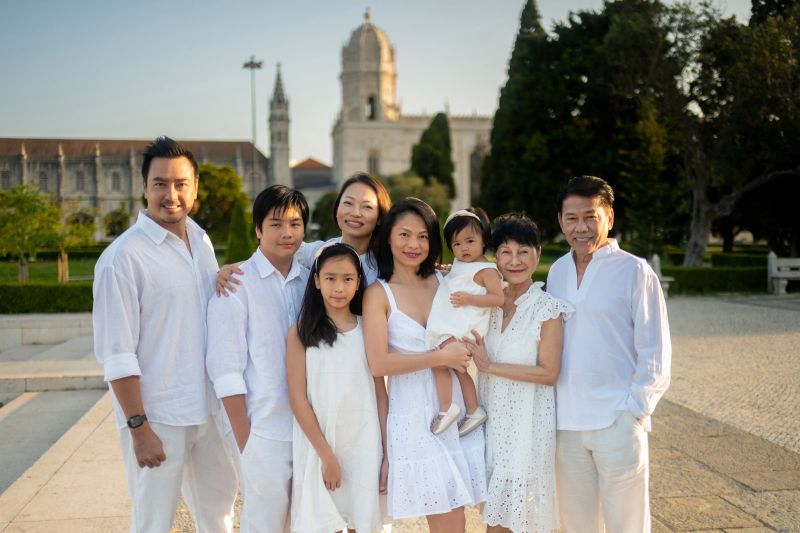
The most recognisable stone in Portugal, and the one place on this list that genuinely rewards getting up in the dark. The monastery facade faces the morning sun, the lawns in front of it are flat and wide, and at dawn there is nobody in them.
I have shot it both ways: a first birthday at the monastery, and a sunrise session when the square was still empty. The lawns are the underrated part – a child who is done with photographs can simply be put down on the grass, which is not true of a viewpoint or a cobbled street.
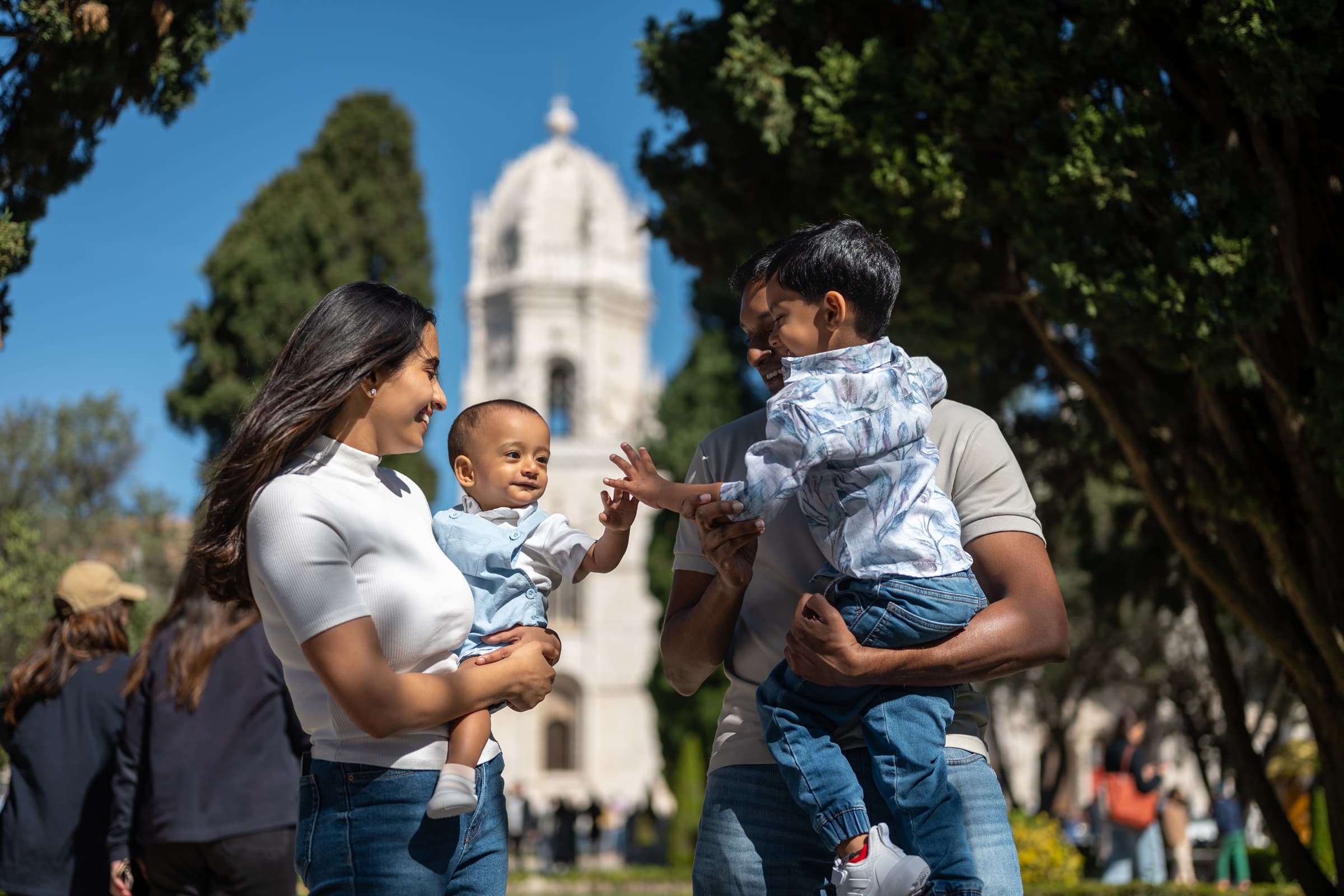
The trade-off: from about nine the queues begin, and by midday the facade is in flat overhead light with several hundred people in front of it.
3. Alfama and the Pantheon
Narrow streets, washing lines, tiles, and the white dome of the National Pantheon above it all. This is where Lisbon looks most like itself, and it works best with children who can walk – a session I did around the Pantheon was essentially a walk that happened to be photographed.
Alfama also solves the shade problem by accident: the streets are so narrow that half of each one is in shadow at almost any hour, which buys you a middle-of-the-day session when nowhere else will give you one.
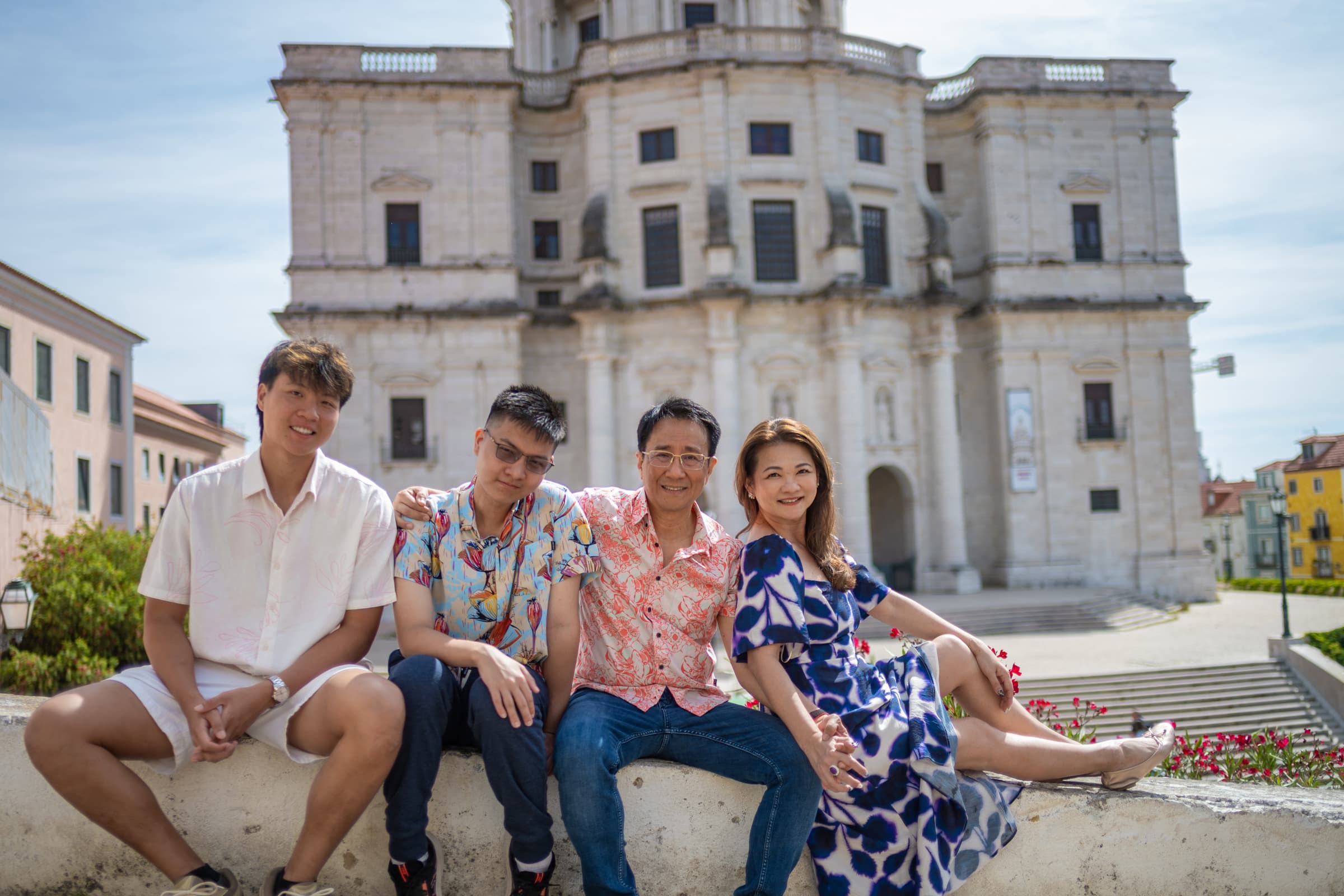
The trade-off: steep, and all of it is calçada. With a pushchair it is hard work; with a newly walking toddler it is a series of small negotiations.
4. Out of the city: Guincho, Cascais and the Sintra coast
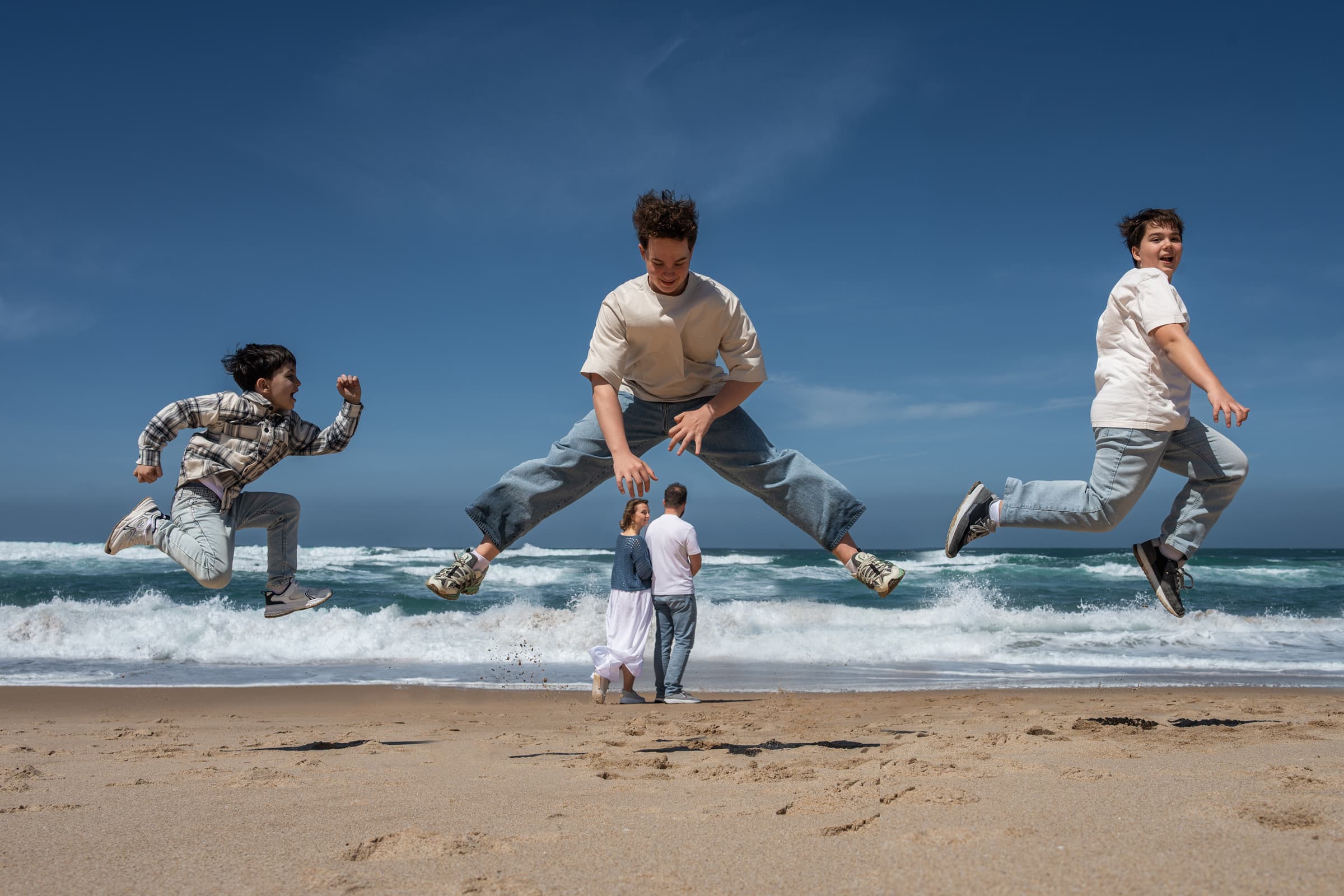
Half an hour west the postcard changes completely – wide beach, low dunes, wind, and the light going gold across all of it. Children who have run out of patience for architecture rediscover it the moment there is sand. This is the part of the coast I use most for families: a session at Guincho and one with a baby on the Sintra side of the same beach, both late in the day, which is when that coast is at its best.
Cascais itself is the gentler version: a small marina, painted houses, a promenade you can walk with a pushchair, and the sea at the end of it. If the drive is only worth doing once, and the youngest child in the family is still very small, Cascais asks less of everyone than the open beach does.
Adraga and Ursa are the most dramatic coastline within reach, and this one needs a warning, because the name misleads. "Praia da Ursa" sounds like an ordinary beach you drive to and walk onto. What actually goes down there is a steep unmade path across the cliff face – not a route for a family shoot, and not something to plan with children or a pushchair.
The good news is that you do not need to go down. The best photographs there are made on top, on the cliffs: the beach below as the view, ocean and rock in the frame behind you. You get the whole drama of the place without a single metre of the descent. I take couples there regularly, and it works with a family too – as long as we agree in advance that we are staying up top.
The forests and palaces of Sintra are the other direction people ask about. Two honest caveats. The town is a genuine traffic and parking problem in season, so a Sintra session eats a morning rather than an hour.
And the important one: photographing inside the palace estates usually means a paid permit, not just a ticket. Commercial photography there needs separate written authorisation, and the rules differ from site to site. I have written the whole thing up separately – what counts as a private shoot against a professional one, who manages what in Sintra (Pena and Monserrate are Parques de Sintra, while Quinta da Regaleira is run by a different foundation with its own rules), and where to send the request: photography permits in Lisbon and Sintra. If you have a particular palace in mind, tell me before we plan the day around it and I will check what is allowed there this season rather than promise it and improvise on the spot.
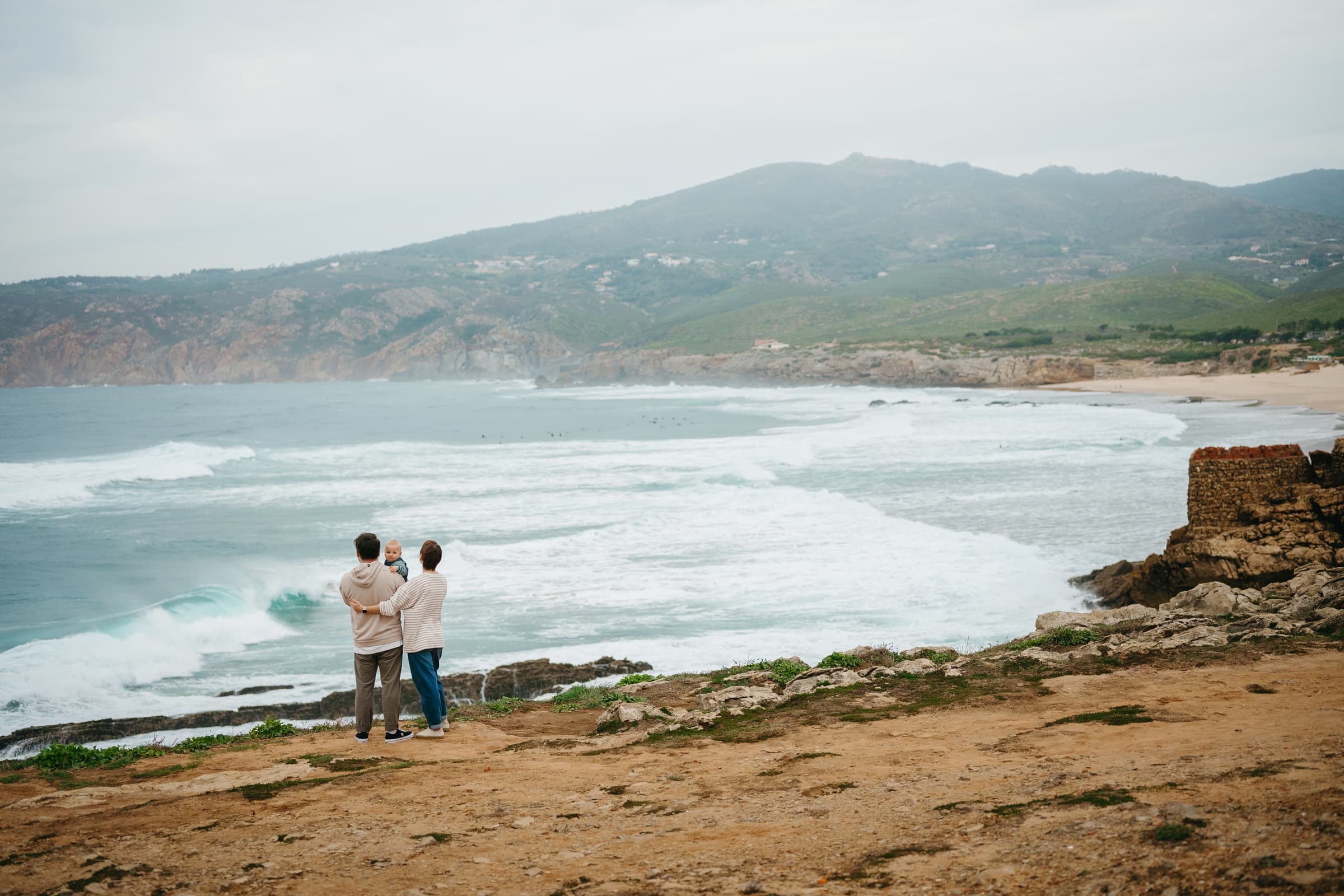
The trade-off on the wild beaches and cliffs: the Atlantic wind is real and it is cold even in August – bring a layer for everyone, including whoever swears they never get cold. And this is a session you build the day around rather than fit between two museums.
5. Gardens, when the children are very small
Jardim da Estrela, Príncipe Real, the terraces of Parque Eduardo VII. None of them says "Lisbon" in a photograph the way the monastery does, and that is exactly why they work for a family with a baby or a toddler who naps at eleven. Big trees, so shade all day. Flat paths, so a pushchair is not a problem. Cafés and toilets inside the park, so the reset is thirty seconds away rather than a taxi ride.
Choose one of these when the priority is that everyone is calm and nobody remembers the session as an ordeal. You trade the landmark for the odds of it going well, and with children under three that is usually the right trade.
When to go: in summer, sunrise beats sunset
Everyone asks for golden hour, meaning the evening. For a family in Lisbon between May and September I will usually argue for the morning one instead, and there are three reasons.
The famous places are empty at dawn and crowded at dusk – the same frame, an hour of waiting or none. Children are at their best in the morning and at their worst at seven in the evening, which is precisely when a summer sunset session would be starting. And the evening light in high summer arrives so late that a small child would be photographed well past bedtime.

From roughly October to March, this reverses. The sun sets early enough that an evening session lands at a civilised hour, and the light is soft for much longer either side of it.
And a specific one about the palaces: sunrise and sunset are simply not available there. The park at Pena opens at 09:00 and closes at 19:00, the palace itself runs 09:30 to 18:30 – while in June the sun rises around six in the morning and sets around nine at night. Both hours of the best light fall outside opening times. In Sintra you photograph in whatever light exists between nine and six, and that is worth knowing before anyone builds a day around "golden hour at the palace".
One thing to plan around whatever the season: nap time. A session that starts twenty minutes after the toddler should have gone to sleep is a session that will produce photographs of a crying toddler. Tell me the nap, and I will build the rest around it.
How long it takes
One hour suits most family sessions. It is enough for one location, two or three small moves around it, and the ten minutes at the start that everyone needs before they stop performing and start behaving normally – which is where the good photographs come from.
Two hours is the next package up, and it is the one to take if you want more than one outfit or two locations near each other. There is no hour-and-a-half option: it is one hour or two. With very small children, longer is not automatically better – after about an hour most of them are finished, and no amount of scheduled time changes that.
What it costs
Family sessions start at €240 for the one-hour package; the packages and what is in each are laid out on the rates page. There is no per-photo limit – I select and edit every frame that works and send them as an online gallery in high resolution.
If you want to do this
Look through family sessions I have photographed in Lisbon to see whether the way I photograph is the way you want to be photographed, then have a look at how a family session works.
Then write to me with your dates, the ages of the children, and the nap. Those three things are enough for me to suggest a place and an hour – and if your dates only allow one morning, say so, and we will use it properly.
I shoot in Lisbon and across Portugal. More about my work: photographer in Lisbon.